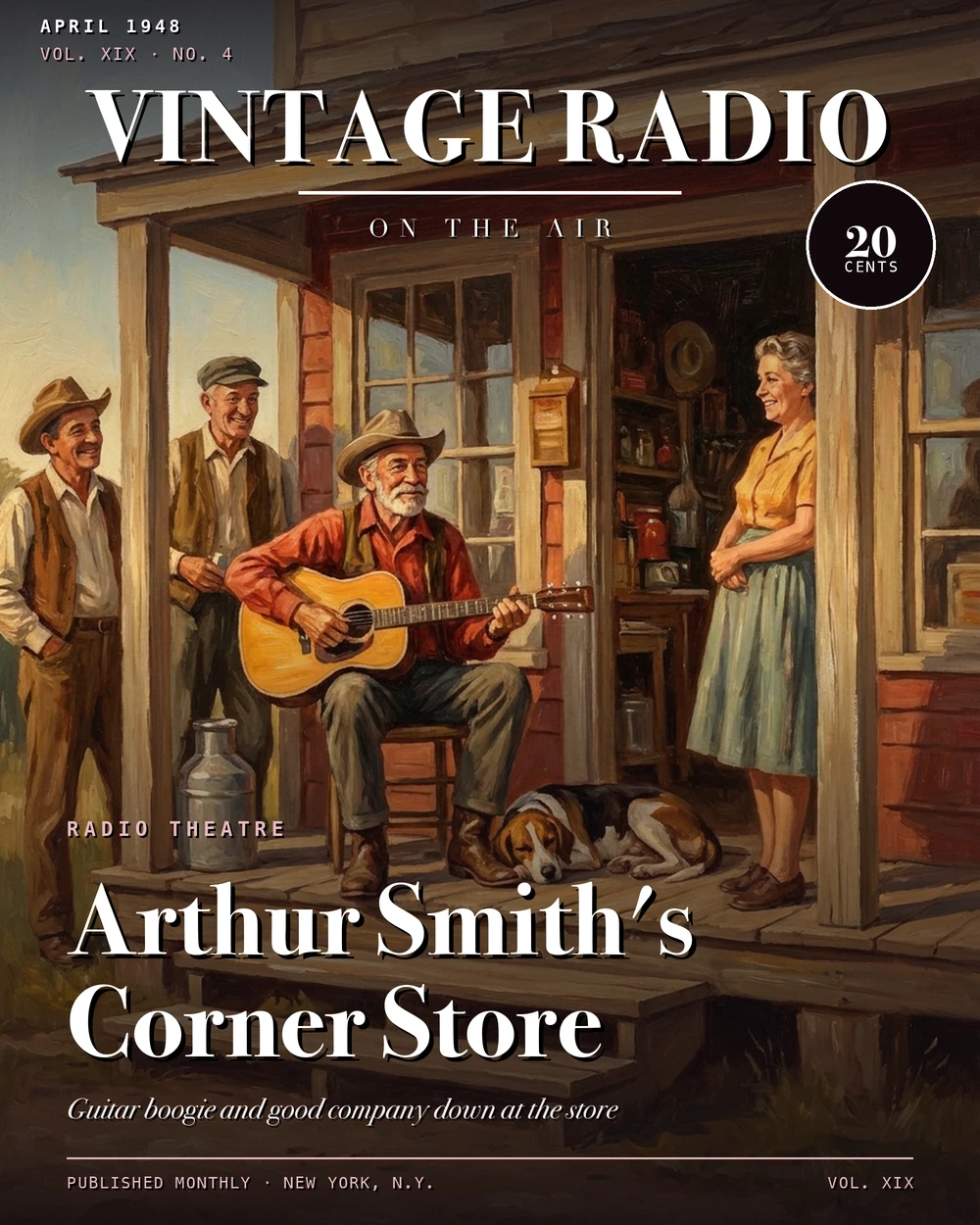
Arthur Smith's Corner Store
The Man Behind the Counter
Before he was suing Warner Brothers over "Dueling Banjos," before he built the first commercial recording studio in the Southeast, and before his television show ran for 32 years in 90 markets, Arthur Smith was doing something far more modest: hosting a 15-minute daily radio program out of Charlotte, North Carolina, that mixed music and comedy for the local WBT audience. The Corner Store was where he worked out his act in public, every day, with his brothers beside him and a traveling salesman cracking jokes in the background.
Arthur "Guitar Boogie" Smith (April 1, 1921 – April 3, 2014) was born in Clinton, South Carolina, and grew up in Kershaw. He was primarily a guitarist — that "Guitar Boogie" nickname was not incidental — as well as a fiddler, banjo player, and multi-instrumentalist who also played trumpet and mandolin. His musical identity was built around a jazz-inflected electric guitar style. The South Carolina Encyclopedia describes him as "best remembered for his jazz-influenced electric-guitar" work, and the band, as historysouth.org notes, had always "loved jazz." That jazz undercurrent set Smith apart from strictly traditional country acts and gave the Corner Store its particular sound.
Smith got his start in radio with a Dixieland jazz band — himself, brother Ralph, and brother Sonny, performing as the Carolina Crackerjacks on WSPA in Spartanburg, South Carolina. The brothers found more commercial traction after switching to country music. Smith joined WBT Charlotte around 1943, and by 1945 he was a featured performer on Carolina Hayride (later renamed Carolina Calling), which aired nationally on CBS from Charlotte each Saturday afternoon. The Corner Store grew out of that Charlotte base as a daily local program, airing in the late 1940s and into the early 1950s.
What the Show Actually Was
The Corner Store was a 15-minute daily transcribed show on WBT, a 50,000-watt CBS-affiliated station. The cast was a family operation: Arthur Smith, brothers Sonny and Ralph, with Clyde McLean handling announcements in character as "Bill Mack, the traveling salesman." Ralph Smith appeared under the character name "Esau Jabberjaw." In later episodes, Tommy Faile and Don Reno — both of whom Smith helped develop into significant figures in Carolina and bluegrass music — joined the group. The show was sponsored by Cheer Detergent and was described as being "filled with happy music and cracker barrel humor."
The format balanced music with comedy sketches and what the show called the "Corner Store Jamboree," a recurring segment that brought in guest musicians. The structure allowed for spontaneous performances and jam sessions, which gave the show an informal, drop-by-the-porch quality that suited the material. The humor and the storytelling were rooted in Southern culture, and the music ranged across country and jazz-inflected territory rather than sitting squarely in any single genre. Songs that serve as episode identifiers in the surviving catalog give a sense of the range: "Guitar Boogie" territory sat alongside titles like "The Angels Are Lighting Gods' Candles," "Peter Cottontail," "A Mighty Pretty Waltz," and the deadpan comedy of "I'm Saving My Coupons" and "If It Ain't One Thing."
Arthur Smith Outside the Corner Store
The Corner Store was a local program, but the man running it was building something considerably larger at the same time. Smith's instrumental "Guitar Boogie," recorded around 1945, sold over three million copies and earned a gold disc from the RIAA — and the nickname that followed him the rest of his life. In 1951, while the Corner Store was still on the air, Smith launched The Arthur Smith Show on television, which became the first country music show to be nationally syndicated on television. It ran for 32 years in 90 markets coast to coast.
In 1955 — after the Corner Store had gone off the air — Smith composed and recorded "Feudin' Banjos" with five-string banjo player Don Reno, the same Don Reno who had appeared on the Corner Store in its later episodes. That tune was used without credit in the 1972 film Deliverance as "Dueling Banjos." Smith sued Warner Brothers and won songwriting credit and royalties. Two years earlier, in 1957, he had founded the first commercial recording studio in the Southeast, at 5457 Monroe Road in Charlotte. The studio produced syndicated radio shows, country albums, jingles, and recordings by Johnny Cash, James Brown, Pat Boone, and Lester Flatt & Earl Scruggs, among others. Smith also wrote nearly 500 songs — many recorded by Cash, Willie Nelson, and Glen Campbell — plus over 100 gospel songs. His syndicated radio program Top of the Morning ran for an unbroken 29 years out of that Charlotte studio.
None of that was visible yet during the Corner Store's run, but Smith was clearly not treating the daily 15-minute local show as the ceiling of his ambitions. The Corner Store was a working platform, a place to develop material, test collaborators, and maintain a direct relationship with a Charlotte audience while the larger projects took shape.
What Survives
The earliest episode in the broadcast catalog dates to November 10, 1952, and the latest to November 26, 1953 — a run of just over a year for the recorded portion. WBT Memories places the Corner Store more broadly in the late 1940s and early 1950s as a daily local program, and the surviving catalog represents a slice of that longer run. Four complete Corner Store shows were recovered from transcription discs by Jim Scancarelli, which accounts for at least part of the surviving episode pool.
The catalog holds 14 episodes identified by their first song, with titles ranging from "Talking To My Mule" and "The Love Bug Itch" to "I'll Sail My Ship Alone" and "Long Gone." A slightly larger count — 18 recordings totaling about four hours and thirteen minutes — appears in other catalogs under the combined title Arthur Smith's Corner Store / Arthur Smith and His Crackerjacks. The Corner Store was a daily local WBT program, distinct from the nationally syndicated Arthur Smith Show that ran simultaneously on television; there is no reliable evidence that the radio Corner Store continued into the 1960s, and the available recordings are consistent with the November 1953 finale date.
What the surviving episodes capture is a working band in a comfortable format — short, informal, built around music and light comedy, with room for guests and the occasional jam. For a program that ran as a daily local show rather than a national network production, the Corner Store left a surprisingly clear record of what Arthur Smith sounded like before he became a television institution.